AI in Public Works: What Happens When a Recommendation Becomes a Work Order?
AI can identify a public works problem. Can your systems carry the decision through work orders, field activity, and finance? Learn what controlled execution requires.
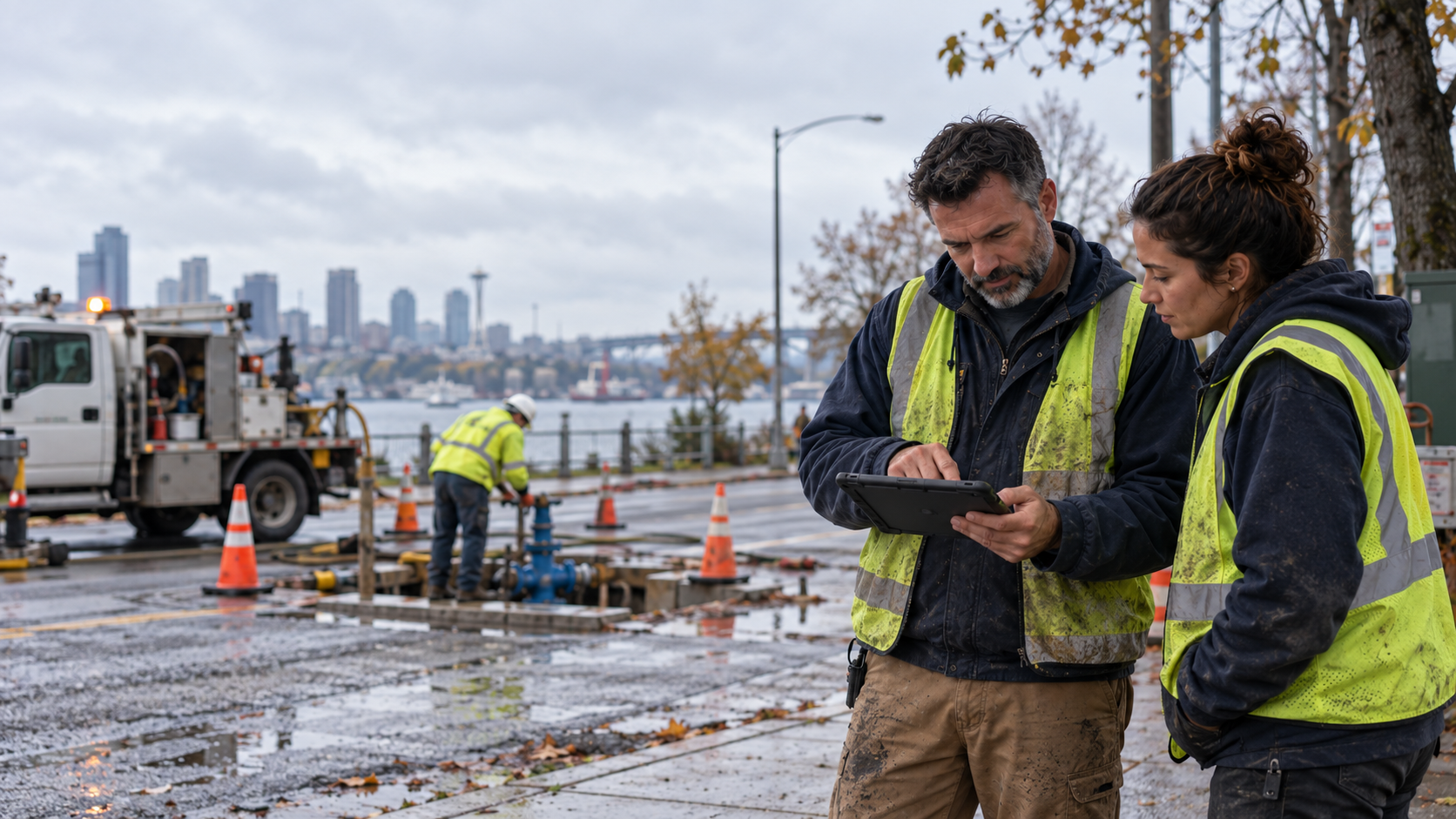
AI in Public Works: What Happens When a Recommendation Becomes a Work Order?
The interesting question about AI in public works is no longer whether it can spot a problem. It is what happens after it does.
Imagine a model that flags a water main for inspection. Its reasoning looks sound: a history of breaks, a recent pressure anomaly, perhaps a cluster of service calls nearby. The recommendation appears on a screen. Then someone has to decide whether it warrants a work order, whether the asset record is current, which crew should see it, and how the work will be paid for and recorded.
This is where a promising AI pilot meets an ordinary Tuesday at the utility.
The model can make a recommendation in seconds. The organization still has to move that recommendation through GIS, asset management, work management, field operations, inventory, and finance. If those systems disagree about the asset, its condition, the job status, or the cost, a faster recommendation may simply arrive at a slower handoff.
AI is getting closer to the work
The shift is real. Esri is expanding AI in ArcGIS toward agents and automated GIS workflows. Its discussion of GIS governance in the AI era raises questions about accountability, data management, and risk as these tools become more capable. NIST has also published an AI Risk Management Framework and, in 2026, began work on a profile for trustworthy AI in critical infrastructure.
For a public works or utility leader, the practical question is more specific: What must be true before an AI-generated recommendation is allowed to change operational work?
Consider that water main again. The AI may identify the right location, while the work management system still holds an old asset identifier. A service request may already be open for the same issue. A crew may be scheduled for nearby work tomorrow. A repair could require a particular approval or cost code. None of those details makes the AI recommendation useless. They determine whether it can become a reliable action.
A recommendation is not an instruction
Before an AI recommendation creates or changes a work order, the organization needs an answer to several questions.
Which record is authoritative? GIS may own the asset geometry, while the asset management system owns its maintenance history and the work management system owns the job. A useful recommendation needs the right context from each without silently changing the wrong record.
What has to be checked? An asset ID, location, open work order, service area, priority, and required fields may all affect the next step. If a required value is missing or two systems conflict, the workflow should hold the action and show someone why.
Who can make the decision? AI might propose an inspection priority. A supervisor may need to approve the job. A different person may authorize an emergency repair or financial commitment. Those boundaries should be explicit before anyone grants an agent access to operational systems.
What happens after the work is done? The recommendation has an operational consequence. Field completion, materials, labor, status updates, and job costs need to reach the systems that depend on them. Otherwise, the original AI insight becomes difficult to evaluate against what actually happened.
Can the organization reconstruct the decision? A team should be able to see the source records, the recommendation, the applicable rule, the human approval, the resulting work order, any failed handoff, and the final outcome. An answer on a dashboard is a poor substitute for that history.
The handoff is where AI earns its keep
Suppose an AI tool recommends inspection of three valves. It is tempting to measure success by whether the predictions were accurate. Accuracy matters, but it is only the opening measure.
Did the recommendation refer to the correct assets? Were duplicate work orders avoided? Did the right supervisor review the work? Did crews receive enough context to act? When the inspection changed the asset condition, did the record update in the right place? Could finance see the labor and materials attached to the job?
The value is established across that chain. A good model can improve a poor process, but it can also expose every unclear ownership rule the process has been living with.
This is why execution control matters. The organization defines which system owns each part of the work, what must be validated, when an action can proceed, when it must wait for a person, how exceptions are handled, and how the outcome is recorded. AI can contribute a recommendation within those boundaries. The workflow carries the decision into reality.
Start with one decision that people already struggle to carry through
Public works teams do not need to begin with an autonomous system that opens every work order it suggests. A better first candidate is a recurring decision with a clear operational trail: an inspection finding that may trigger maintenance, a service request that may become a work order, or a completed job whose costs must reach finance.
Map the decision from beginning to end. Identify the source records, the person who currently checks them, the conditions that make the action valid, and the point at which the result becomes visible in another system. Then look for the manual checks, duplicate entries, delayed updates, and exceptions that already consume staff time.
AI can help people recognize patterns or prepare a recommendation. The workflow should make it clear what happens next. That includes a deliberate place for human judgment when the evidence is incomplete or the consequences are significant.
The question to ask before the next AI pilot
Ask the team to trace one proposed AI action all the way through the organization. If it recommends a repair, who verifies the asset? Who authorizes the work? What creates the work order? What happens if the API call fails? Where do field results and costs land? Who can explain the outcome a month later?
If the answers live in different people's heads, that is the work to do first.
AI in public works will become more useful as its recommendations become more relevant. Its operational value will depend on something less fashionable and far more consequential: whether a city or utility can turn a good recommendation into work it can carry out, account for, and trust.
Want to find the first handoff to fix? Explore Spatial DNA's Execution Control Layer or talk with our team.
Frequently asked questions
How can AI be used in public works?
AI can help teams identify patterns in asset condition, service requests, inspections, and operational data, then recommend work or help staff review information. Any action that changes a work order, asset, customer, or financial record needs clear ownership, validation, and oversight.
Can AI automatically create work orders?
Technically, an AI-connected workflow can create a work order through an approved system interface. Whether it should do so depends on the quality of the source data, the risk of the action, duplicate checks, approval rules, and the ability to review what happened. Some recommendations should be routed to a person first.
What is the difference between an AI recommendation and controlled execution?
The recommendation suggests what might need to happen. Controlled execution defines what is allowed to happen, checks the relevant records and rules, routes approvals and exceptions, performs the action across systems, and records the result.