Field to Finance Integration: Where Public Works Costs Become Financial Truth
Discover how Field to Finance integration turns completed public works activity into accurate, traceable costs across ERP, EAM and inventory systems.
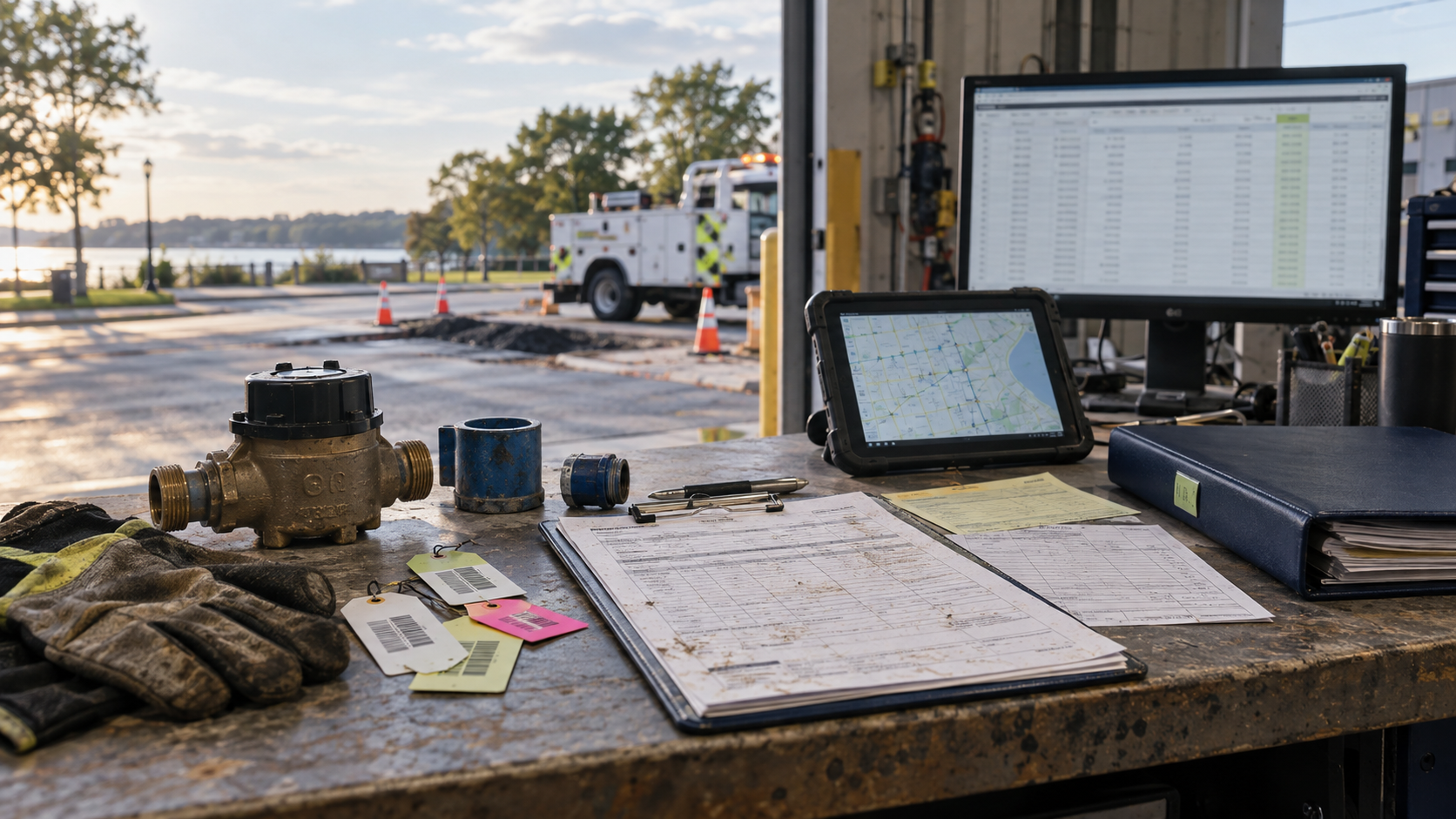
There is a moment in every public works job when the work stops being operational and becomes financial. A crew may have repaired the pipe, replaced the meter, inspected the asset or completed the maintenance.
From the field's perspective, the work is finished. But the organization is not finished with it.
The labour has to become cost. The materials have to become cost. Equipment, inventory, contractors, project codes and account allocations all have to find their way into the financial record.
This is the journey from Field to Finance. It sounds straightforward until you watch it happen.
Because somewhere between a completed work order and a trusted financial transaction, the work often passes through several systems, multiple people and a surprising number of small decisions. That is where things become interesting and expensive.
The Work Order Is Finished. The Financial Story Is Not.
A work order can be perfectly valid operationally and still be incomplete financially. Perhaps the field crew has closed the job but one employee has not submitted their time. Perhaps materials were consumed but inventory has not yet posted the transaction. Perhaps the work was charged against the wrong project. Perhaps the account code does not exist in the ERP.
Perhaps the work order was changed after the cost information was originally prepared.
None of these situations is particularly dramatic.
That is precisely why they matter. Small discrepancies are rarely treated as emergencies. Instead, people build processes around them.
The repair may be finished on Tuesday, but the work is not finished with it. Someone still has to run the report, check the totals, correct the account, resubmit the batch, and compare what the ERP says against what appears in the work management system. By the time every discrepancy has been traced and every number reconciled, the operational work is already days behind us. The job was repaired on Tuesday. The financial truth may not emerge until Friday.
Sometimes later.
Field to Finance integration exists to close that distance.
The Cost of Work Is More Than an Accounting Question
It is easy to think of this as a Finance problem.
It is not.
The real cost of work affects decisions across the organization.
If a city cannot reliably determine what it costs to maintain a particular asset, it becomes harder to understand when maintenance is still economical and when replacement becomes the better decision.
If emergency work is not correctly attributed, budgeting becomes less accurate.
If labour or inventory costs arrive late, operational reporting becomes less reliable.
If work orders and financial records do not reconcile easily, supervisors spend time explaining numbers rather than managing work.
Over time, a small integration problem begins influencing capital planning, maintenance strategy, budgeting and management confidence.
That is why the question, What did this job cost?, deserves a better answer than a spreadsheet assembled three days later.
Where Field to Finance Usually Breaks
It creates accountability around the movement.
The Cost of Work Is More Than an Accounting Question
It is tempting to think of job costing as a Finance problem. A matter of accounts, transactions and reconciliation. But the cost of work does not stay neatly inside the finance department. It travels much further.
When a city cannot reliably determine what it costs to maintain a particular asset, it becomes harder to know whether continued maintenance still makes economic sense or whether replacement has become the better decision. When emergency work is attributed incorrectly, budgets begin carrying a distorted version of reality. When labour and inventory costs arrive days after the work itself, operational reporting becomes less dependable. And when work orders and financial records refuse to reconcile cleanly, supervisors find themselves explaining numbers instead of managing the work those numbers are supposed to represent.
None of these failures appears especially dramatic on its own. That is partly why they persist. But over time, what began as a small gap between systems starts influencing maintenance strategy, capital planning, budgeting and, eventually, management’s confidence in the information being used to make decisions.
Which is why a question as simple as What did this job cost? deserves a better answer than a spreadsheet assembled three days later.
Where Field to Finance Usually Breaks
The problem is rarely that the systems themselves are incapable of holding the information. The ERP knows how to record the financial transaction. The EAM or work management system knows what happened on the work order. The inventory system knows which materials were consumed. The time system knows who worked, for how long and, ideally, against which job.
Each system can be perfectly correct on its own.
The difficulty begins when all of those separate facts must become one trusted financial event.
Imagine a maintenance job has been completed in the field. The repair is done, the crew has moved on and operationally the work appears finished. Yet before Finance can trust the cost attached to that job, a series of other questions may still be waiting for answers. Has all of the labour been entered? Were the required approvals completed? Did inventory post correctly? Are the account and project codes valid? Is the work order genuinely ready to close? Has any portion of the cost already been transferred once before?
Moving data between two systems does not answer those questions. It merely moves the data.
That is the difference between an integration and a controlled Field to Finance workflow. The integration knows where information needs to go. The workflow knows whether it should go, when it is ready to go, and what must happen when something is wrong.
Much of the value sits inside that distinction.
Why Manual Reconciliation Survives So Long
Manual reconciliation survives for a surprisingly simple reason: people are very good at making broken processes work.
A Finance analyst notices that the totals look wrong and investigates. A supervisor remembers that a work order is still missing labour. An inventory clerk recognizes that a part number has changed. Someone in accounting knows that the ERP requires a code the operational system never captures, so they add it manually before the transaction goes through.
The process works because someone is always watching it.
And gradually, almost without anyone deciding that this should happen, the organization begins to depend on that invisible layer of human intervention. The manual check becomes part of the process. The spreadsheet becomes the accepted record. The workaround develops its own instructions. The employee who understands all the exceptions becomes the person everyone calls when something does not reconcile.
Nothing has failed spectacularly, so nothing appears urgent enough to replace.
Years can pass this way.
There is an uncomfortable irony in that. The more capable your people are, the longer a poor workflow can survive, because they keep rescuing it before anyone sees how fragile it really is.
A Better Field to Finance Workflow
A better model begins earlier, before an incomplete or incorrect transaction ever reaches Finance.
Instead of allowing the ERP to become the place where problems are finally discovered, the workflow validates the financial event while there is still time to correct it cleanly. It can confirm that labour has been entered, materials have been captured, account information is valid and the necessary approvals have occurred before anything is allowed to move downstream.
And when something is wrong, the transaction should stop deliberately.
It should not disappear between systems. It should not fail silently. It should not surface three days later as an unexplained discrepancy buried inside a report.
The workflow should know where the failure occurred, preserve the history of what happened and route the exception to the person who can actually resolve it. Once corrected, the transaction should be able to continue from that point without being recreated, duplicated or manually reconstructed somewhere else.
That changes the operating model entirely.
The organization is no longer simply moving data between systems. It is controlling the financial journey of the work itself, from the moment the job is completed to the moment its cost can be trusted.
The Importance of Knowing What Happened
Financial integration becomes far more valuable when it is observable.
Suppose a work order appears in the ERP with a cost that someone questions six months later.
A traditional investigation may involve comparing records across systems, finding old emails and asking the people who were involved whether they remember what changed.
A controlled workflow should provide a much better answer.
It should be possible to see when the work order became eligible for posting, what information was validated, whether anything failed, what was corrected and when the final transaction was accepted.
That history changes the conversation.
Instead of reconstructing what probably happened, the organization knows what happened.
For public organizations that operate under increasing expectations around governance, auditability and financial transparency, that distinction matters.
Field to Finance Is Also an Operational Visibility Problem
One of the most persistent problems in public works is that operational and financial reporting often run on different clocks.
Operations may know today that a job has been completed.
Finance may know the final cost days later.
Management may not see a complete picture until the next reporting cycle.
That delay matters because the organization is making decisions in the meantime.
When Field to Finance works well, there is less distance between operational reality and financial visibility.
The result is not only cleaner accounting.
It is better management information.
A supervisor can see whether work is costing more than expected.
A manager can identify unusual material consumption.
Leadership can compare planned and actual costs sooner.
Patterns become visible before they become year-end discoveries.
When a Work Order Should Not Post Automatically
Automation is sometimes described as though the ideal state is to remove every human decision.
That is rarely the right objective.
There are transactions that should stop.
There are exceptions that need judgement.
There are situations where a supervisor should review something before Finance receives it.
A useful Field to Finance integration does not eliminate control in pursuit of speed.
It automates what is predictable and makes the exceptions visible.
This is an important principle.
The objective is not straight-through processing at any cost.
The objective is straight-through processing when the conditions are right, with intelligent intervention when they are not.
That is how automation increases confidence instead of simply increasing velocity.
The Work Order Costing Problem Is Often an Integration Problem
Organizations sometimes respond to unreliable work-order costing by adding reporting, introducing new procedures or asking employees to enter more information.
Those changes can help, but they often treat the symptoms.
If the same information exists in several systems, if updates arrive at different times or if the financial transaction depends on a sequence of events that nobody is controlling centrally, more reporting will not solve the fundamental issue.
The workflow itself needs attention.
This is where ERP integration for public works and Field to Finance become closely connected.
The ERP does not need to know every operational detail.
The operational system does not need to become an accounting platform.
What the organization needs is a reliable way to govern the moment when operational information becomes financial information.
That is the handoff.
And the handoff is where most of the complexity lives.